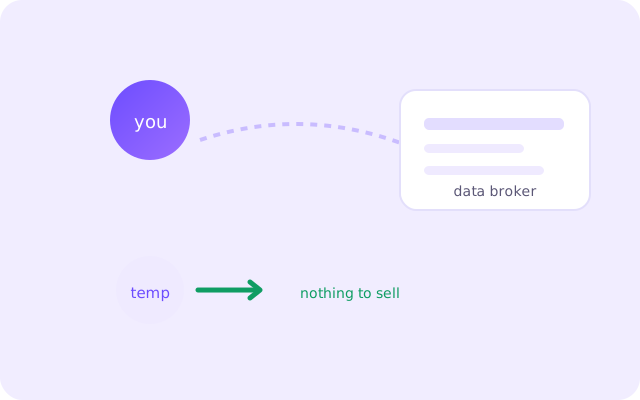
Most people meet data brokers through their consequences: a sudden wave of mail addressed to a slightly wrong version of their name, or calls about a service they barely remember signing up for. The address was not stolen in a dramatic breach. It was collected, packaged and sold, and the sign-up you half-forgot was the handshake.
How an address becomes a data point
On its own, an email address is a key. What makes it valuable is everything that can be attached to it: a name, a rough location, shopping habits, which services you use, how often you open mail. Brokers do not need your permission to build that picture; they need only for your address to appear in enough places that the puzzle pieces can be matched together.
Newsletter platforms, loyalty schemes, competition entries and free downloads are all places an address surfaces. Individually harmless, collectively a profile.
The sign-up is the handshake
When you hand over your real address, you are rarely dealing with one company. Behind the form sit marketing tools, analytics pipelines and partner integrations, and any of them can be the point where your address leaves the circle you intended. The wording in the privacy policy — “we may share with trusted partners” — is often exactly this.
You cannot audit all of that. You can, however, choose what you hand over.
Why deletion requests rarely finish the job
Asking a broker to remove your data is worth doing, and in some regions it is a legal right. But a deletion request works on the copies a broker admits to holding. It does not reach the list that was already sold, the cached version, or the partner who received your address two years ago. Deletion reduces exposure; it does not undo it.

The preventive move
The one action that reliably keeps your real address out of broker lists is to stop handing it to services that have not earned it. A disposable inbox makes that practical: you get the confirmation, the download or the trial, and the address that reaches the company’s systems is one that expires before it is worth reselling. When the list is later traded, the buyer gets a dead address.
A two-address strategy that actually works
Two addresses, clearly divided, solve most of the problem before it starts:
- A primary address for people, work, finance and anything you must be able to recover. Guard it fiercely and give it to almost no one.
- A disposable address for every sign-up you are only trying, every gated download and every one-off trial.
If you want a third, a permanent “shopping” address sits between them for services you genuinely keep. The point is not to be paranoid; it is to make the decision once, in advance, instead of improvising at every form.
Seen this way, a temp inbox is not a trick to dodge marketing. It is the front door you use for anything that has not yet earned the back door.
Aliases: a middle ground worth knowing
If you want the privacy of disposable addresses with the durability of a permanent one, aliases are the middle path. An alias is a forwarding address that hides your real inbox and can be switched off individually, so you can hand a different one to every service and see instantly who leaked or sold it. Many mail providers offer this natively. The trade-off is that an alias still belongs to an account you maintain, whereas a throwaway address asks nothing of you at all. For the sign-ups you truly do not care about, disposable still wins; for the ones you keep but do not trust, an alias is the sharper tool.
Frequently asked questions
What is a data broker?
A company that collects contact and behavioural data from many sources, combines it into profiles, and sells or licenses those profiles to marketers and others.
Can I get my email removed from broker lists?
In many regions you can request deletion, and it is worth doing. But it only reaches copies a broker acknowledges, not lists already sold or cached, so it reduces exposure rather than erasing it.
Does a disposable address stop data brokers?
It stops your real address from entering their lists in the first place. The broker may still hold the throwaway address, but it expires before it is worth much and reveals nothing about you.
Is my real address already out there?
If you have used it for sign-ups, competitions or downloads, it very likely has been collected. That is a reason to protect it going forward, not a reason to give up on the habit.