A disposable inbox is a privacy tool, but a narrow one. Used for the right job it quietly removes a real problem; used for the wrong one it can give a false sense of safety. This guide draws the line plainly, so you always know which side of it you are on.
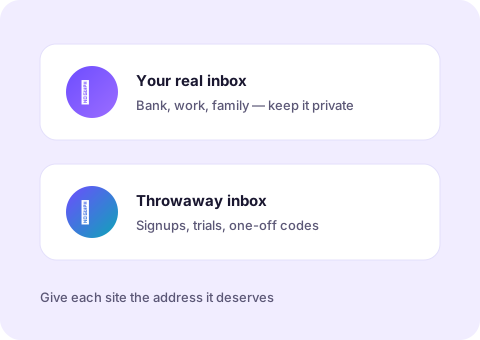
What "private" means for a throwaway inbox
Start with what a temp address is not. It is not an encrypted vault, and it is not anonymous in the strong sense. What it is, is an address with no identity attached: it asks nothing about you, it is not tied to your name or phone number, and it disappears on a timer. Its privacy comes from disconnection and impermanence, not from secrecy.
That is enough for the job it is built for. It is not enough for everything.
What it protects
- Your real address. Sites you sign up to never receive the address your friends and bank use, so they cannot leak, sell or spam it.
- Your identity link. A temp inbox asks for no name, no phone number and no existing account, so the address cannot be joined to your other profiles.
- Your attention. Marketing sequences, onboarding nudges and re-engagement campaigns go to an address that will soon stop existing.
- Your trail. Nothing is left behind: when the inbox expires, its messages go with it.
What it cannot protect
Now the honest part. A disposable inbox does not:
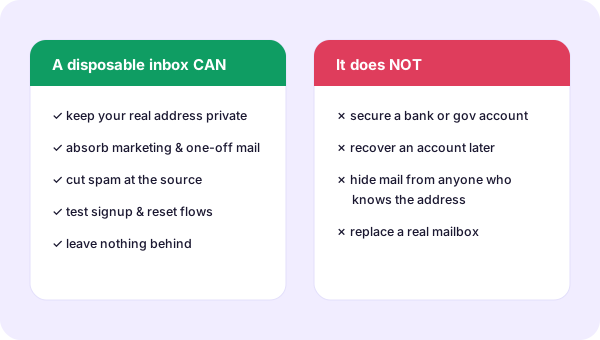
- Keep mail secret from anyone who knows the address. The address itself is the key. Anyone who has it can read what arrives there, so sensitive mail does not belong in a temp inbox.
- Secure an account that matters. Bank, payment and government accounts should never be tied to a throwaway address, because you cannot recover them later.
- Survive expiry. By design the inbox deletes itself, which means the reset link you might need next month will be gone.
- Make you anonymous against a determined observer. The service still sees traffic to its own domain, and the sites you visit still see you visit them. A temp inbox changes the address you hand over, not everything else.
Metadata and the legal picture
Privacy is never only about the address. Even a throwaway inbox lives on a server, and a server can be asked for records. A disposable address is a sensible way to avoid being marketed at and to keep your real address out of careless hands; it is not a shield against a lawful request for data, and it is not meant to be. If you need protection at that level, a temp inbox is the wrong instrument.
Where the catch-all model fits
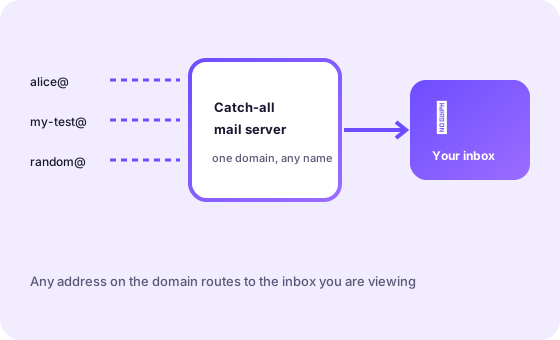
Understanding the machinery helps you use it well. A temp mail service is a catch-all server: it accepts mail for any name on its domain and routes it to the inbox you are watching. That is why addresses appear instantly and why there is no password — the address is the credential. It is also why the "anyone with the address can read it" caveat is structural rather than a bug: convenience and open access are the same design decision.
Practical rules that follow
- Use a temp inbox for: one-off sign-ups, trials, gated downloads, coupons, and anything you are merely curious about.
- Use your real address for: banking, payments, government services, work, and any account you would be upset to lose.
- Never route sensitive mail through a temp inbox — receipts with card details, reset links for important accounts, or anything you would not want a stranger to read.
- Keep a permanent secondary address for the handful of services you actually keep, so you are never forced to choose between a burner and your primary inbox.
The honest summary
A disposable inbox is excellent at one thing: keeping your real address out of places that do not deserve it. That is a real and worthwhile protection — it cuts spam, limits leaks and removes you from marketing lists. What it is not is a universal privacy shield. Understand the boundary, use it on the right side of it, and it will do its job without ever giving you a false sense of safety.
A common misconception
People sometimes assume a temp inbox makes them anonymous online. It does not, and it is worth saying so plainly. The site you sign up to still knows you visited; your network and browser still leave their own traces; and the mail service still operates a server. What the disposable address removes is narrower and more useful than anonymity: it removes the link between that sign-up and the address you care about. Judge it against that goal and it performs well. Judge it against total anonymity and it will always disappoint.